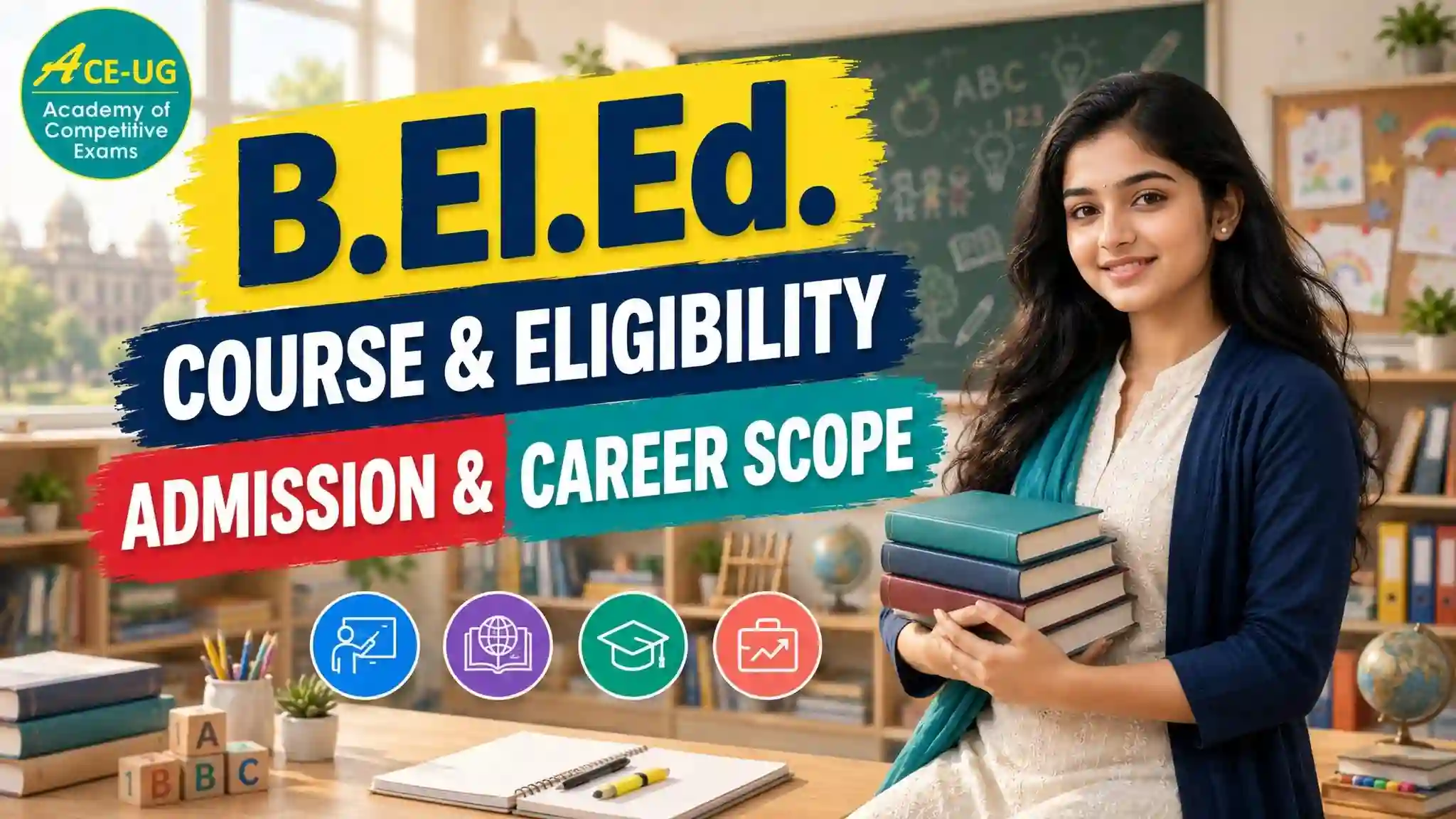
Bachelor of Elementary Education (B.El.Ed.): Course, Eligibility, Admission and Career Scope
The Bachelor of Elementary Education (B.El.Ed.) is a four-year integrated professional degree programme designed for students who want to build a career in elementary school education. The course combines subject knowledge, child development, educational psychology, teaching methods, classroom practice, and school internships to prepare students for the teaching profession.
Unlike a general undergraduate degree, B.El.Ed. integrates academic study with professional teacher education from the beginning. It is a suitable option for students who have completed Class 12 and want to explore teaching and other careers related to education.
For students considering B.El.Ed. through CUET-UG, understanding the eligibility criteria, admission process, colleges, syllabus, and future opportunities is essential before applying.
What Is Bachelor of Elementary Education (B.El.Ed.)?
Bachelor of Elementary Education, commonly known as B.El.Ed., is an undergraduate professional programme focused on preparing teachers for elementary education. The programme generally covers the educational needs of children during the elementary stage, commonly Classes I to VIII.
The degree combines knowledge of school subjects with an understanding of how children learn and develop. Students explore teaching strategies, curriculum design, assessment methods, inclusive education, and practical classroom experiences.
The programme also introduces students to the social and psychological factors that influence learning. Through school internships and practical assignments, students gain opportunities to observe classrooms, develop teaching skills, and understand the responsibilities of an educator.
The B.El.Ed. programme is recognised within the teacher-education framework regulated by the National Council for Teacher Education (NCTE).
B.El.Ed. Course Highlights
| Particulars | Details |
|---|---|
| Full Form | Bachelor of Elementary Education |
| Course Type | Undergraduate professional degree |
| Duration | 4 years |
| Eligibility | Class 12 or equivalent, subject to university requirements |
| Admission Route | CUET-UG and the participating university’s admission process, where applicable |
| Main Areas of Study | Education, child development, teaching methods, subject knowledge and assessment |
| Practical Training | Practicum, classroom activities and school internship |
| Career Areas | Elementary teaching, curriculum development, educational content and further studies |
| Regulatory Framework | National Council for Teacher Education (NCTE) |
Course structure, admission requirements, and available career opportunities depend on the institution and applicable recruitment rules.
B.El.Ed. Eligibility Criteria
Students planning to pursue B.El.Ed. should check the eligibility requirements of their preferred university before applying.
Educational Qualification
Candidates generally need to have passed Class 12 or an equivalent examination from a recognised board.
Minimum Marks
The minimum aggregate percentage is determined by the relevant university and its admission rules. Candidates should check the latest admission bulletin for the required marks and applicable category-related provisions.
For example, the University of Delhi’s 2026–27 programme-specific information lists an aggregate of 45% marks or an equivalent grade point for B.El.Ed. applicants. Students must refer to the official bulletin for the complete criteria and applicable conditions.
Subject Requirements
Universities may prescribe a particular combination of language and domain subjects for CUET-UG. Students should verify the required combination for B.El.Ed. before choosing their CUET subjects.
Entrance Examination
For participating University of Delhi colleges, admission is based on the prescribed CUET-UG subject combination and the university’s admission and seat-allocation process.
Meeting the minimum eligibility criteria does not guarantee admission. Candidates must also fulfil the applicable selection requirements.
B.El.Ed. Admission Process Through CUET-UG
Students applying to participating University of Delhi colleges should follow the admission instructions published for their admission year.
Step 1: Check the Official Eligibility Criteria
Read the latest university admission bulletin to confirm the minimum marks, required CUET subjects, and any additional conditions.
Step 2: Register for CUET-UG
Complete the CUET-UG application through the National Testing Agency’s official website. Provide accurate academic and personal details.
Official website: https://cuet.nta.nic.in/
Step 3: Select the Required CUET Subjects
Choose the language and domain subjects required for the B.El.Ed. programme. Do not rely on general advice or another course’s subject combination; follow the exact requirements published by the university.
Step 4: Appear for CUET-UG
Prepare according to the official syllabus and examination pattern for the subjects selected.
Step 5: Complete the University Admission Registration
After the entrance examination, complete the relevant university registration and programme-preference process within the prescribed deadlines.
Step 6: Select Colleges and Check Seat Allocation
Choose eligible colleges in the required preference order and monitor the official allocation rounds.
Step 7: Complete Admission Formalities
If a seat is allocated, submit the required documents, complete verification, and pay the prescribed admission fee within the deadline.
Important: CUET-UG registration and university admission registration may be separate steps. Students must complete every required stage to be considered for admission.
B.El.Ed. Colleges in Delhi
The University of Delhi has offered B.El.Ed. through selected colleges. Students interested in pursuing this programme in Delhi can explore the following institutions and verify their current course availability.
1. Aditi Mahavidyalaya
Aditi Mahavidyalaya is a University of Delhi college that offers the B.El.Ed. programme. Students can explore its teacher-education curriculum and practical learning opportunities.
Official website: https://aditi.du.ac.in/
2. Gargi College
Gargi College is a University of Delhi college known for its undergraduate programmes, including teacher education. Students should check the current B.El.Ed. admission information and course details.
Official website: https://www.gargicollege.in/
3. Institute of Home Economics
The Institute of Home Economics offers B.El.Ed. as a four-year integrated professional teacher-education programme. Its course integrates subject knowledge, human development, pedagogy, communication, and practical training.
Official website: https://ihe.du.ac.in/
4. Jesus and Mary College
Jesus and Mary College has offered B.El.Ed. as part of its undergraduate academic programmes. Applicants should check its latest programme-specific information and admission requirements.
Official website: https://www.jmc.ac.in/
5. Lady Shri Ram College for Women
Lady Shri Ram College for Women is another institution students can explore for teacher education and related academic opportunities. Verify the latest B.El.Ed. programme listing and seat availability before including it in your preference list.
Official website: https://lsr.edu.in/
How to Choose a B.El.Ed. College
Before selecting a college, compare the following factors:
The list above is a starting point for research, not a ranking. Always check the official admission information for the relevant academic year before applying.
B.El.Ed. Syllabus and Subjects
The B.El.Ed. syllabus combines academic subjects with professional teacher training. The precise curriculum varies by university and may be organised into semesters or other prescribed academic units.
Common areas of study include the following.
1. Child Development
Students learn about physical, cognitive, emotional, linguistic, and social development during childhood. This knowledge helps future teachers understand the different needs and learning patterns of children.
2. Educational Psychology
This area explores how students learn, what motivates them, how they develop thinking skills, and how teachers can support different learning needs.
3. Philosophical and Sociological Foundations of Education
Students examine the relationship between education, society, culture, equality, and social change. They also explore the purpose of schooling and the role of teachers in society.
4. Language and Literacy Education
This area focuses on language development, reading comprehension, writing, communication, and methods for teaching languages at the elementary level.
5. Mathematics Education
Students explore ways to teach mathematical concepts, develop logical reasoning, address common learning difficulties, and make mathematics accessible to children.
6. Environmental and Social Studies Education
Students learn how to introduce children to their natural environment, communities, society, and everyday experiences through age-appropriate learning activities.
7. Science Education
Depending on the curriculum, students explore methods for teaching scientific concepts through observation, experimentation, questioning, and practical activities.
8. Curriculum and Pedagogy
This area focuses on lesson planning, instructional methods, learning objectives, classroom activities, and the selection of suitable teaching resources.
9. Assessment and Evaluation
Students learn how to evaluate learning progress, provide feedback, identify learning gaps, and use different assessment methods.
10. School Internship and Practicum
Practical training gives students opportunities to observe classroom teaching, prepare lessons, participate in school activities, and develop their teaching skills under supervision.
Students should consult the official syllabus of their selected college for the complete subject and semester structure.
Skills Developed During B.El.Ed.
B.El.Ed. helps students develop a combination of academic, professional, and interpersonal skills.
These skills are useful not only for classroom teaching but also for educational content development, curriculum support, and further study in education.
Career Opportunities After B.El.Ed.
B.El.Ed. can lead to several professional and academic pathways. However, eligibility for a particular teaching post depends on the relevant recruitment notification, recognised qualifications, teacher-eligibility requirements, and applicable regulations.
1. Elementary School Teacher
Graduates may pursue elementary teaching positions in eligible government or private schools, subject to the applicable recruitment and qualification requirements.
2. Private School Educator
Private schools may recruit qualified candidates for teaching positions according to their own requirements and the relevant education regulations.
3. Curriculum Developer
Graduates with suitable skills and experience can explore work involving curriculum design, lesson planning, learning resources, and educational programme development.
4. Educational Content Developer
Educational publishers, learning platforms, and edtech organisations may recruit candidates to develop worksheets, lesson material, educational videos, and age-appropriate learning content.
5. Academic Coordinator
With relevant experience and additional qualifications where required, graduates may explore academic coordination, teacher support, and school programme management.
6. Education Research
Students interested in research can pursue higher studies and explore research opportunities in child development, teaching practices, educational policy, and learning assessment.
7. Higher Education and Specialisation
Graduates may pursue further studies in Education and related disciplines, subject to the eligibility criteria of the institution and programme.
Salary After B.El.Ed.
There is no single salary figure for all B.El.Ed. graduates. Earnings depend on the school, location, job role, experience, recruitment rules, and additional qualifications.
Government school salaries are determined by the relevant recruitment rules and pay structure. Private school salaries can vary considerably according to the institution and responsibilities.
Graduates interested in teaching should review the eligibility conditions and pay details in official recruitment notifications rather than relying on a general salary estimate.
Difference Between B.El.Ed. and B.Ed.
B.El.Ed. and B.Ed. are both professional teacher-education qualifications, but they differ in their usual entry point and programme structure.
| Feature | B.El.Ed. | B.Ed. |
|---|---|---|
| Full Form | Bachelor of Elementary Education | Bachelor of Education |
| Entry Point | After Class 12 | Traditionally after completing a bachelor’s degree or another qualifying degree, subject to current regulations |
| Duration | 4 years | Commonly 2 years under the conventional programme structure |
| Programme Type | Integrated undergraduate teacher-education degree | Professional teacher-education degree |
| Main Focus | Elementary education and child-centred teaching | Professional preparation for teaching at the levels permitted by applicable rules |
| Practical Training | Integrated practicum and school internship | Teaching practice and internship as prescribed by the programme |
| Eligibility for Teaching Posts | Depends on the post’s qualification and recruitment rules | Depends on the post’s qualification and recruitment rules |
Students should not assume that either qualification automatically makes them eligible for every teaching position. Check the latest NCTE regulations and the recruitment notification for the post you intend to pursue.
Is B.El.Ed. a Good Course After Class 12?
B.El.Ed. can be a suitable option for students who are genuinely interested in teaching, child development, and elementary education.
The course is particularly relevant for students who want to enter teacher education directly after Class 12 rather than first completing a general bachelor’s degree and then pursuing a separate professional teaching qualification.
Before choosing B.El.Ed., consider the following questions:
If the answers align with your interests, B.El.Ed. may be worth considering as part of your undergraduate college planning.
Frequently Asked Questions (FAQs)
1. What is the full form of B.El.Ed.?
B.El.Ed. stands for Bachelor of Elementary Education. It is a four-year integrated professional degree programme designed to prepare students for elementary education.
2. How many years does B.El.Ed. take to complete?
The B.El.Ed. programme generally takes four years to complete, including professional coursework, practical activities, and school internship.
3. Can I pursue B.El.Ed. after Class 12?
Yes. B.El.Ed. is designed as an undergraduate professional programme after Class 12 or an equivalent qualification, subject to the institution’s eligibility criteria.
4. Is CUET-UG required for B.El.Ed. admission?
For participating University of Delhi colleges, admission follows the prescribed CUET-UG and university admission process. Requirements may differ across institutions, so applicants should check the official rules for their chosen college.
5. What is the minimum percentage required for B.El.Ed.?
The required percentage depends on the institution and applicable admission rules. For DU’s 2026–27 admission information, consult the official programme-specific criteria rather than relying on older brochures.
6. What subjects are taught in B.El.Ed.?
Common areas include child development, educational psychology, curriculum and pedagogy, language education, mathematics education, assessment, and school internship.
7. What can I do after B.El.Ed.?
Graduates can explore eligible elementary teaching positions, educational content development, curriculum support, education research, and further study. Eligibility for each role depends on the relevant requirements.
8. Can B.El.Ed. graduates apply for government teaching jobs?
They may apply for teaching positions for which they meet the prescribed qualifications. Government recruitment rules may specify additional requirements, such as a teacher eligibility test or other conditions.
9. Is B.El.Ed. better than B.Ed.?
Neither course is universally better. B.El.Ed. is an integrated undergraduate programme after Class 12, while B.Ed. is traditionally pursued after graduation. The right choice depends on your educational stage and career goals.
10. Where can I find the official B.El.Ed. admission details?
Students applying to University of Delhi colleges should check the DU admission portal and the relevant college website. They can also consult the National Council for Teacher Education for teacher-education regulations.
Conclusion
Bachelor of Elementary Education (B.El.Ed.) is a four-year integrated professional degree for students interested in teaching and elementary education. The programme combines subject knowledge, child development, pedagogy, assessment, and practical school experience to help students develop the skills required for educational careers.
Before applying, check the current eligibility criteria, CUET-UG subject combination, participating colleges, course structure, and admission deadlines. Students should also understand the qualification requirements for their intended teaching posts.
With careful course selection and a clear understanding of the profession, B.El.Ed. can provide a strong foundation for students who want to contribute to children’s learning and development.